Return to Genetic Double Dual Origin of Modern Man and pre-Modern Man.
Summary
In 1995, researchers discovered that the CCR5delta32 “mutation” allowed people to be asymptomatic to the AIDS virus. Ongoing research has revealed that, along with being helpful with a host of health problems, including cancer and stroke recovery, CCR5delta32 also enhances intelligence. The timing, positive selection, and migration patterns lend support the Urantia Paper’s description of the Adamic genetic uplift and the assimilation of these genes into humanity’s gene pool.
From the Urantia Papers:
To appreciate the related research requires familiarity with three sections from Paper 78: The Violet Race After the Days of Adam—4: The Andites, 5: The Andite Migrations, and 6: The Last Andite Migrations.
Also consider:
(78:0.1) THE second Eden was the cradle of civilization for almost thirty thousand years. Here in Mesopotamia the Adamic peoples held forth, sending out their progeny to the ends of the earth, and latterly, as amalgamated with the Nodite and Sangik tribes, were known as the Andites. From this region went those men and women who initiated the doings of historic times, and who have so enormously accelerated cultural progress on Urantia.
(78:0.2) This paper depicts the planetary history of the violet race, beginning soon after the default of Adam, about 35,000 B.C., and extending down through its amalgamation with the Nodite and Sangik races, about 15,000 B.C., to form the Andite peoples and on to its final disappearance from the Mesopotamian homelands, about 2000 B.C.
(79:1.1) For over twenty-five thousand years, on down to nearly 2000 B.C., the heart of Eurasia was predominantly, though diminishingly, Andite. In the lowlands of Turkestan the Andites made the westward turning around the inland lakes into Europe, while from the highlands of this region they infiltrated eastward. Eastern Turkestan (Sinkiang) and, to a lesser extent, Tibet were the ancient gateways through which these peoples of Mesopotamia penetrated the mountains to the northern lands of the yellow men. The Andite infiltration of India proceeded from the Turkestan highlands into the Punjab and from the Iranian grazing lands through Baluchistan. These earlier migrations were in no sense conquests; they were, rather, the continual drifting of the Andite tribes into western India and China.
(81:5.1) Biologic evolution and cultural civilization are not necessarily correlated; organic evolution in any age may proceed unhindered in the very midst of cultural decadence. But when lengthy periods of human history are surveyed, it will be observed that eventually evolution and culture become related as cause and effect. Evolution may advance in the absence of culture, but cultural civilization does not flourish without an adequate background of antecedent racial progression. Adam and Eve introduced no art of civilization foreign to the progress of human society, but the Adamic blood did augment the inherent ability of the races and did accelerate the pace of economic development and industrial progression. Adam’s bestowal improved the brain power of the races, thereby greatly hastening the processes of natural evolution.
(76:4.7) The body cells of the Material Sons and their progeny are far more resistant to disease than are those of the evolutionary beings indigenous to the planet. The body cells of the native races are akin to the living disease-producing microscopic and ultramicroscopic organisms of the realm. These facts explain why the Urantia peoples must do so much by way of scientific effort to withstand so many physical disorders. You would be far more disease resistant if your races carried more of the Adamic life.
(51:1.8) On Jerusem the loyal children of any Adam and Eve are immortal, but the offspring of a Material Son and Daughter procreated subsequent to their arrival on an evolutionary planet are not thus immune to natural death. There occurs a change in the life-transmitting mechanism when these Sons are rematerialized for reproductive function on an evolutionary world. The Life Carriers designedly deprive the Planetary Adams and Eves of the power of begetting undying sons and daughters. If they do not default, an Adam and Eve on a planetary mission can live on indefinitely, but within certain limits their children experience decreasing longevity with each succeeding generation.
(76:4.5) Both the physical and spiritual visions of Adam and Eve were far superior to those of the present-day peoples. Their special senses were much more acute, and they were able to see the midwayers and the angelic hosts, the Melchizedeks, and the fallen Prince Caligastia, who several times came to confer with his noble successor. They retained the ability to see these celestial beings for over one hundred years after the default. These special senses were not so acutely present in their children and tended to diminish with each succeeding generation.
(78:8.5) When these barbarian cavalrymen from the northeast overran the whole Euphrates valley, they did not conquer the remnants of the Andites who dwelt about the mouth of the river on the Persian Gulf. These Sumerians were able to defend themselves because of superior intelligence, better weapons, and their extensive system of military canals, which were an adjunct to their irrigation scheme of interconnecting pools. They were a united people because they had a uniform group religion. They were thus able to maintain their racial and national integrity long after their neighbors to the northwest were broken up into isolated city-states. No one of these city groups was able to overcome the united Sumerians.
Related research
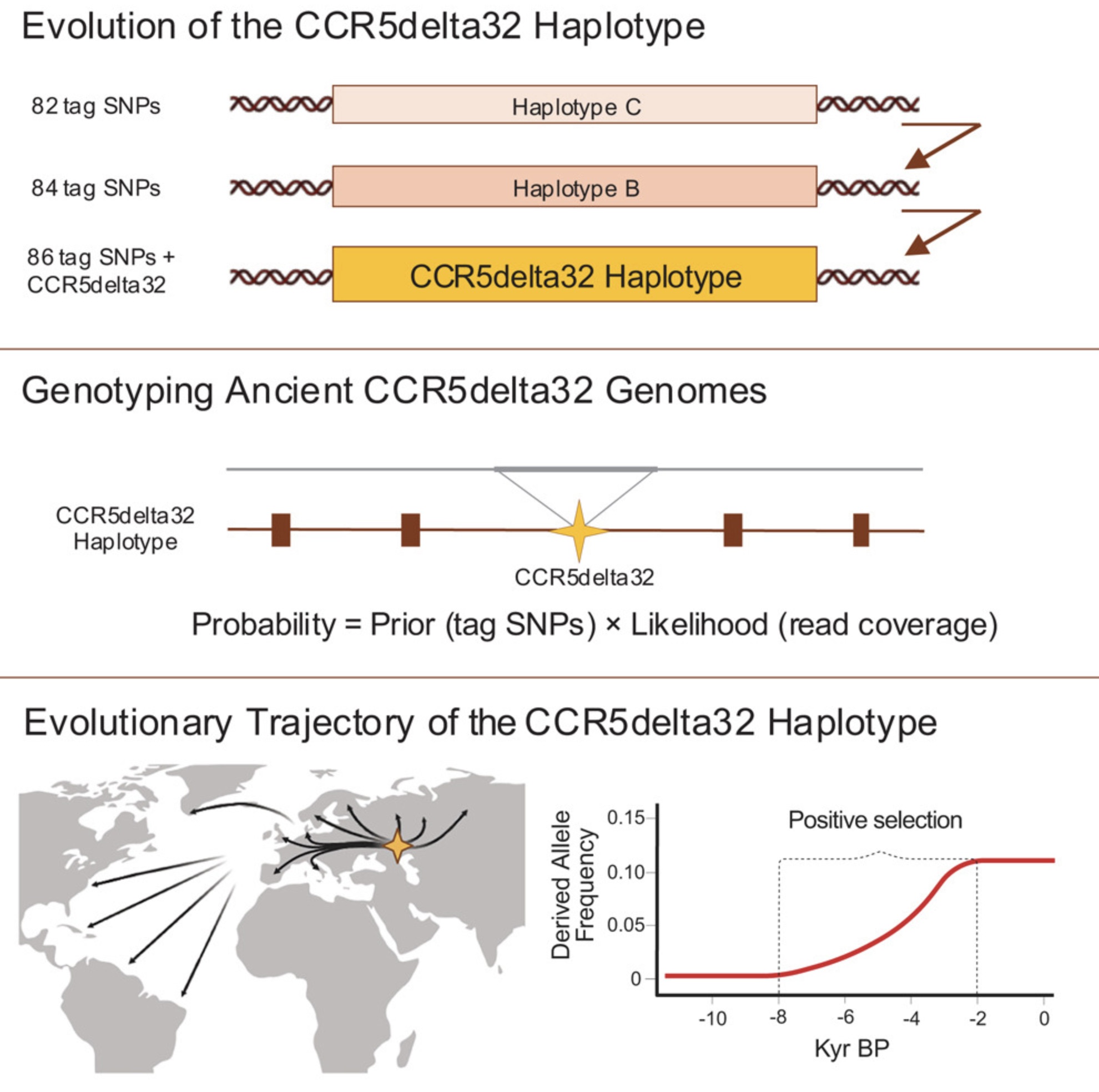
On May 5, 2025, Cell published: Tracing the evolutionary history of the CCR5delta32 deletion via ancient and modern genomes. The summary highlights how timing and positive selection dispersion correlates with the last dispersion of the Andites:
The chemokine receptor variant CCR5delta32 is linked to HIV-1 resistance and other conditions. Its evolutionary history and allele frequency (10%–16%) in European populations have been extensively debated. We provide a detailed perspective of the evolutionary history of the deletion through time and space. We discovered that the CCR5delta32 allele arose on a pre-existing haplotype consisting of 84 variants. Using this information, we developed a haplotype-aware probabilistic model to screen 934 low-coverage ancient genomes and traced the origin of the CCR5delta32 deletion to at least 6,700 years before the present (BP) in the Western Eurasian Steppe region. Furthermore, we present strong evidence for positive selection acting upon the CCR5delta32 haplotype between 8,000 and 2,000 years BP in Western Eurasia and show that the presence of the haplotype in Latin America can be explained by post-Columbian genetic exchanges. Finally, we point to complex CCR5delta32 genotype-haplotype-phenotype relationships, which demand consideration when targeting the CCR5 receptor for therapeutic strategies.
The knowledge that CCR5 is required for HIV-1 infection of lymphoid cells plus the suspicion that CCR5 function is dispensable for good health stimulated pharmaceutical development of a dozen new anti-AIDS treatments termed “HIV entry inhibitors”.
In February 2021, ScienceDirect published: Insight into the roles of CCR5 in learning and memory in normal and disordered states. This excerpt highlights that CCR5 relates to both disease and intelligence:
Accumulating evidence indicates that chemokine receptors play an important role in cognition (Stuart and Baune, 2014). One widely studied chemokine receptor is CCR5 (C–C-chemokine receptor 5). CCR5 is a seven-membrane, G protein-coupled receptor (GPCR) highly enriched in the hippocampal CA1 (Torres-Munoz et al., 2004). CCR5 is expressed on a variety of immune cells, including T lymphocytes, macrophages, and dendritic cells. In the brain, it is highly expressed in microglia and to a lesser extent in astrocytes and neurons (Cartier et al., 2005, Fantuzzi et al., 2019, Tran et al., 2007, Westmoreland et al., 2002).
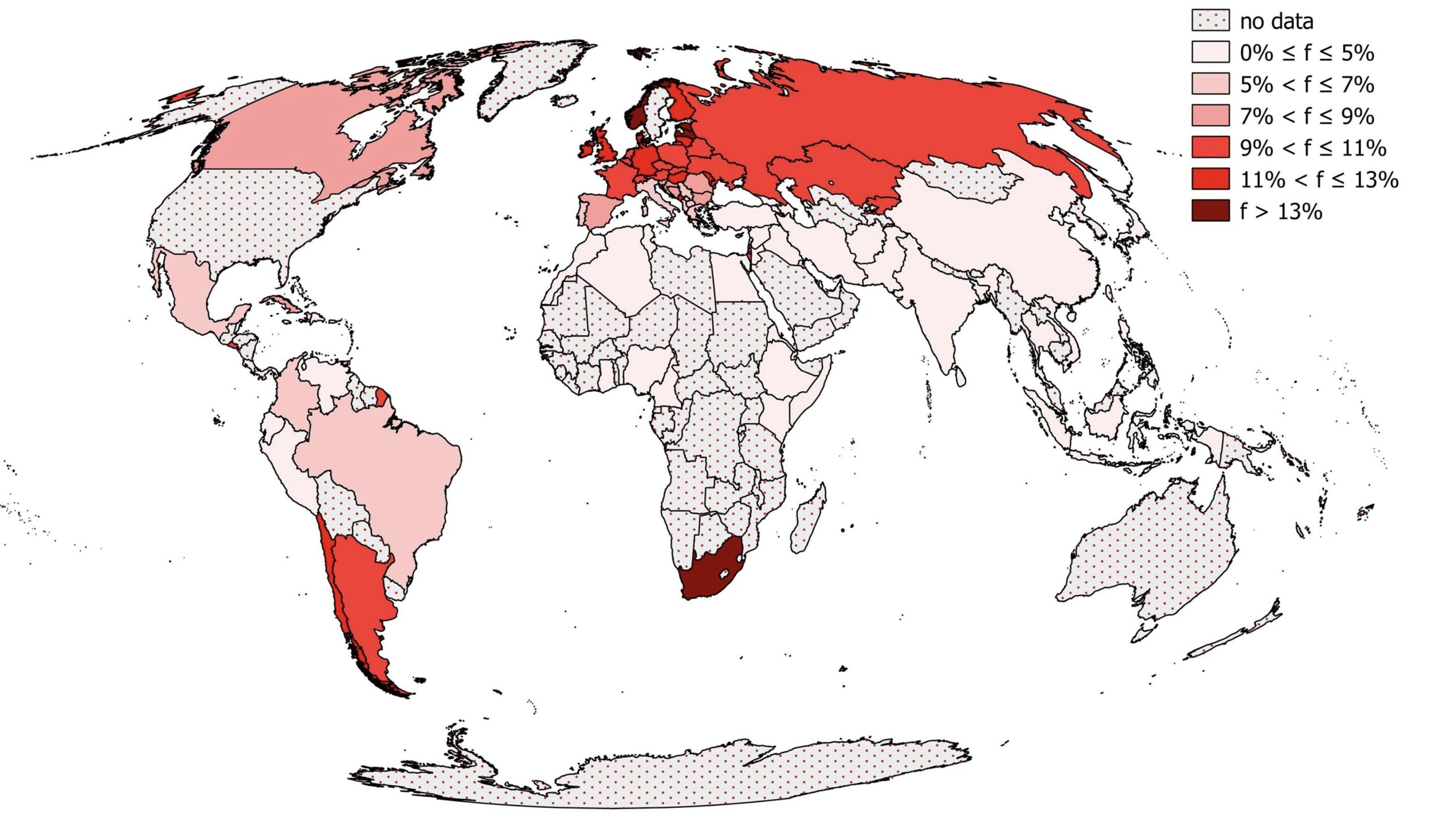 In November 2017, Human Immunology published: Frequecies of gene variant CCR5-delta32 in 87 countries based on next-generation sequencing of 1.3 million individuals sampled from 3 national DKMS donor centers.
Prof He Jiankui shocked the world when he genetically altered the twins to try to give them protection against HIV.