Inner Ionosphere Quick Summary:
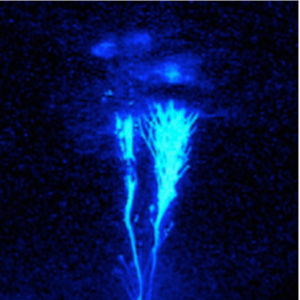
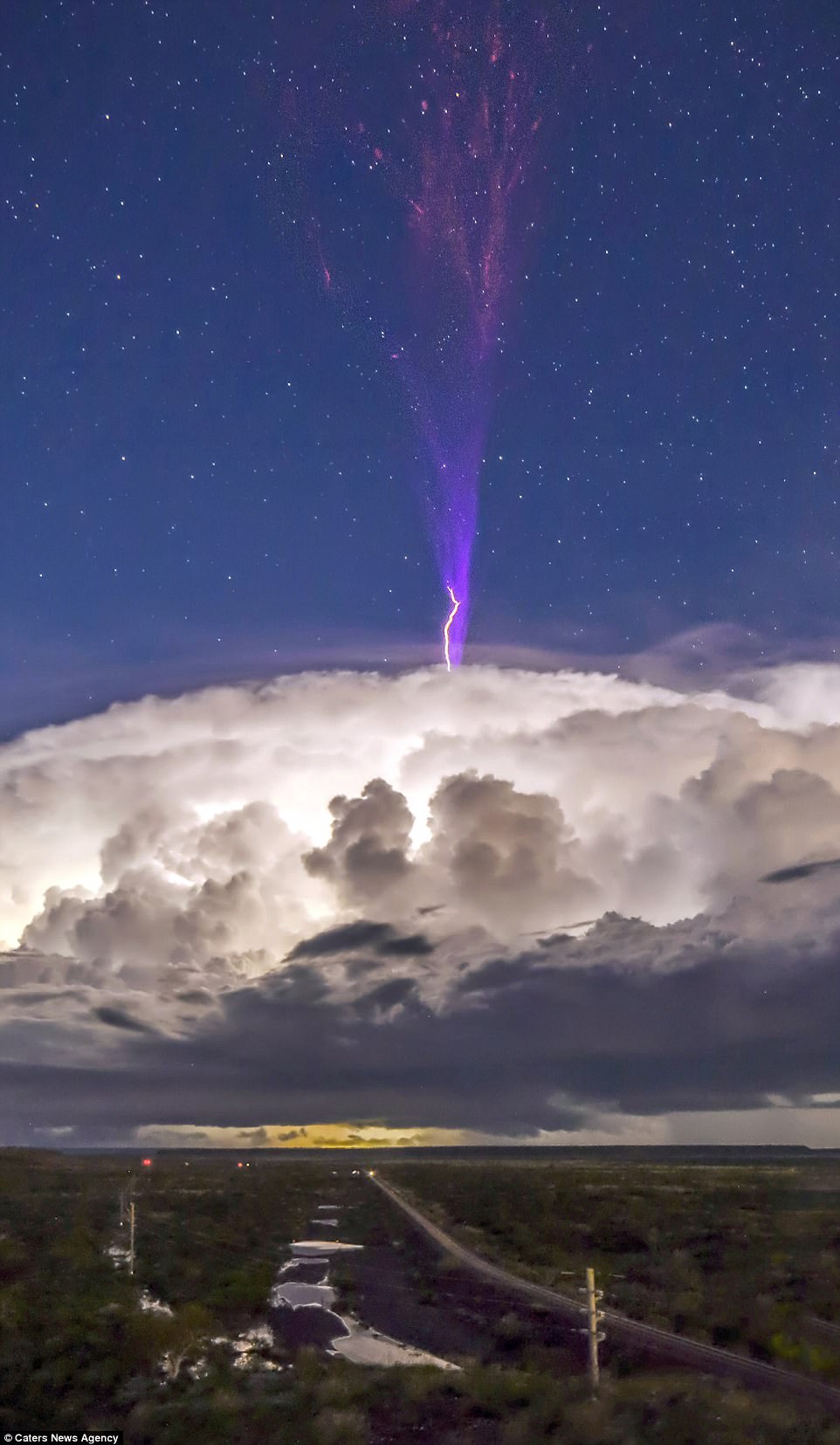
Blue jets shooting up out of storm clouds.
In discussing earth’s atmosphere, The Urantia Book states the following at 58:2.6, “The lower five or six miles of the earth’s atmosphere is the troposphere; this is the region of winds and air currents which provide weather phenomena. Above this region is the inner ionosphere and next above is the stratosphere.” Urantia Book enthusiasts and critics alike have long considered this statement to be a mistake because the longstanding understanding of the earth’s atmosphere has been that the ionosphere exists above the stratosphere.
However, in the late 1980’s and early 1990’s, over thirty years after The Urantia Book‘s publication, observation of “blue jets” were conclusively documented and accepted as an atmospheric condition. Notwithstanding that this phenomenon is still not well understood, what has been learned about blue jets indicates that there must be an ionospheric layer below the stratosphere. Blue jets form above thunderclouds and often reach a height of about 25 miles above sea level. The long-recognized ionosphere, which exists above the stratosphere, begins at around 30 miles above sea level.
Calculations based on videos taken of blue jets, as well as other associated research, indicate that the ionic condition necessary to create their luminescent quality could not have its source in the thunderclouds over which they occur.
Inner Ionosphere Overview
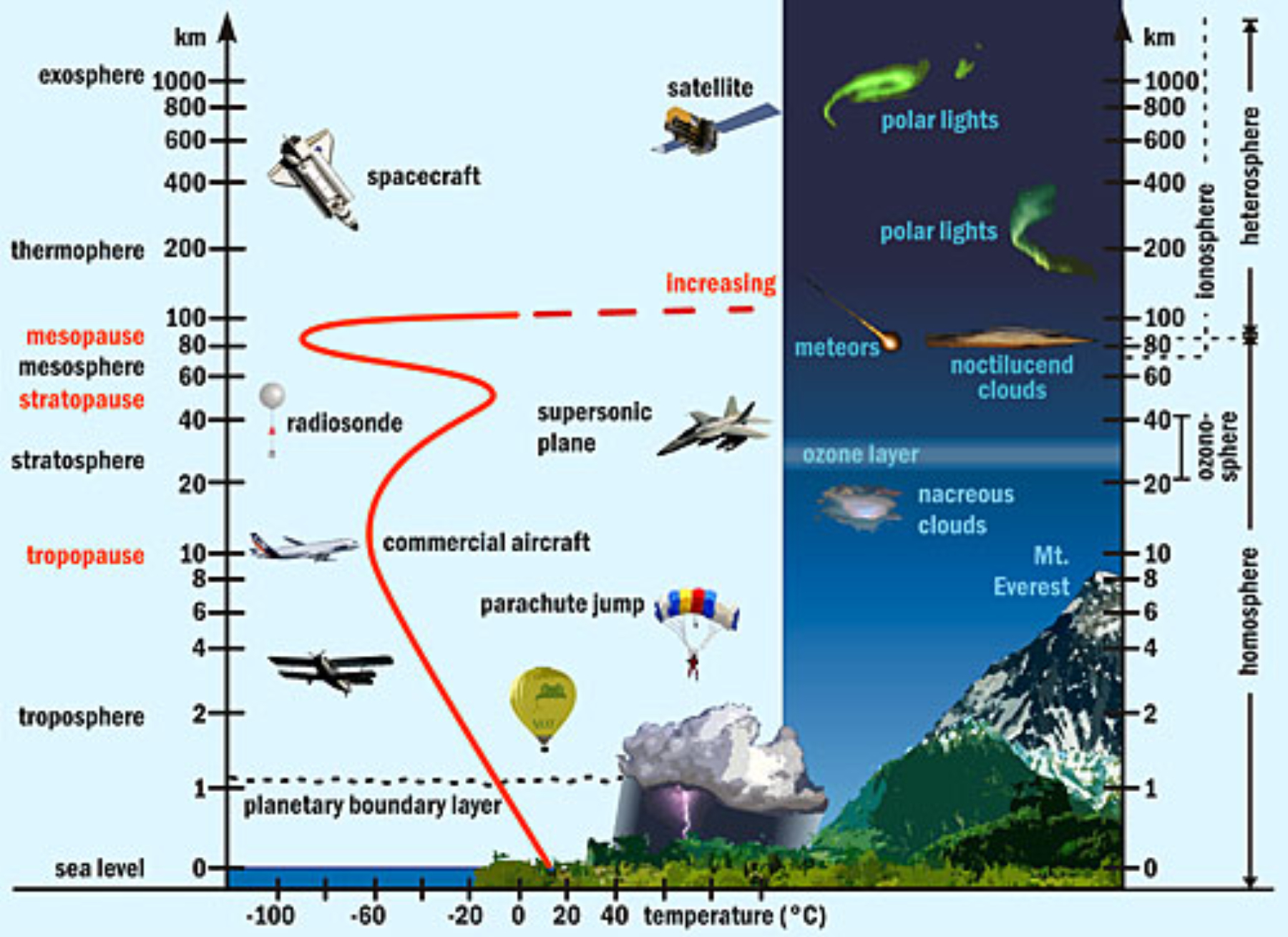 For most of the twentieth century, the scientific community believed that it could confidently describe the various regions of our atmosphere. One of these regions, the ionosphere, starts at about forty miles above sea level. Prior to the documentation of “blue jets,” a broad scientific consensus held that only at high altitude were the necessary conditions present for an ionic layer to exist. The Urantia Book, published in 1955, directly contradicted this scientific consensus by asserting, “The lower five or six miles of the earth’s atmosphere is the troposphere; this is the region of winds and air currents which provide weather phenomena. Above this region is the inner ionosphere and next above is the stratosphere.”
In order for luminescent events to occur in the atmosphere, ions must be present. Ions are atoms that are missing an electron. When atmospheric conditions support ions floating around freely, the luminescent events become diffuse, as with the Aurora Borealis (the Northern Lights). When ions are not already present, electrical discharges through the atmosphere break off electrons from atoms only in the very localized region of their trajectory. This is why lightening bolts are narrow, not diffuse, when they shoot down to the ground.
Blue jets are electrical discharges that originate at the top of thunderclouds and then shoot upwards. Sometimes they shoot up as high as thirty miles, but usually they only extend several miles. “Blue starters” flash in a manner similar to blue jets but they do not have much vertical height. As can be seen from the images, the luminescence of blue jets quickly becomes diffuse.
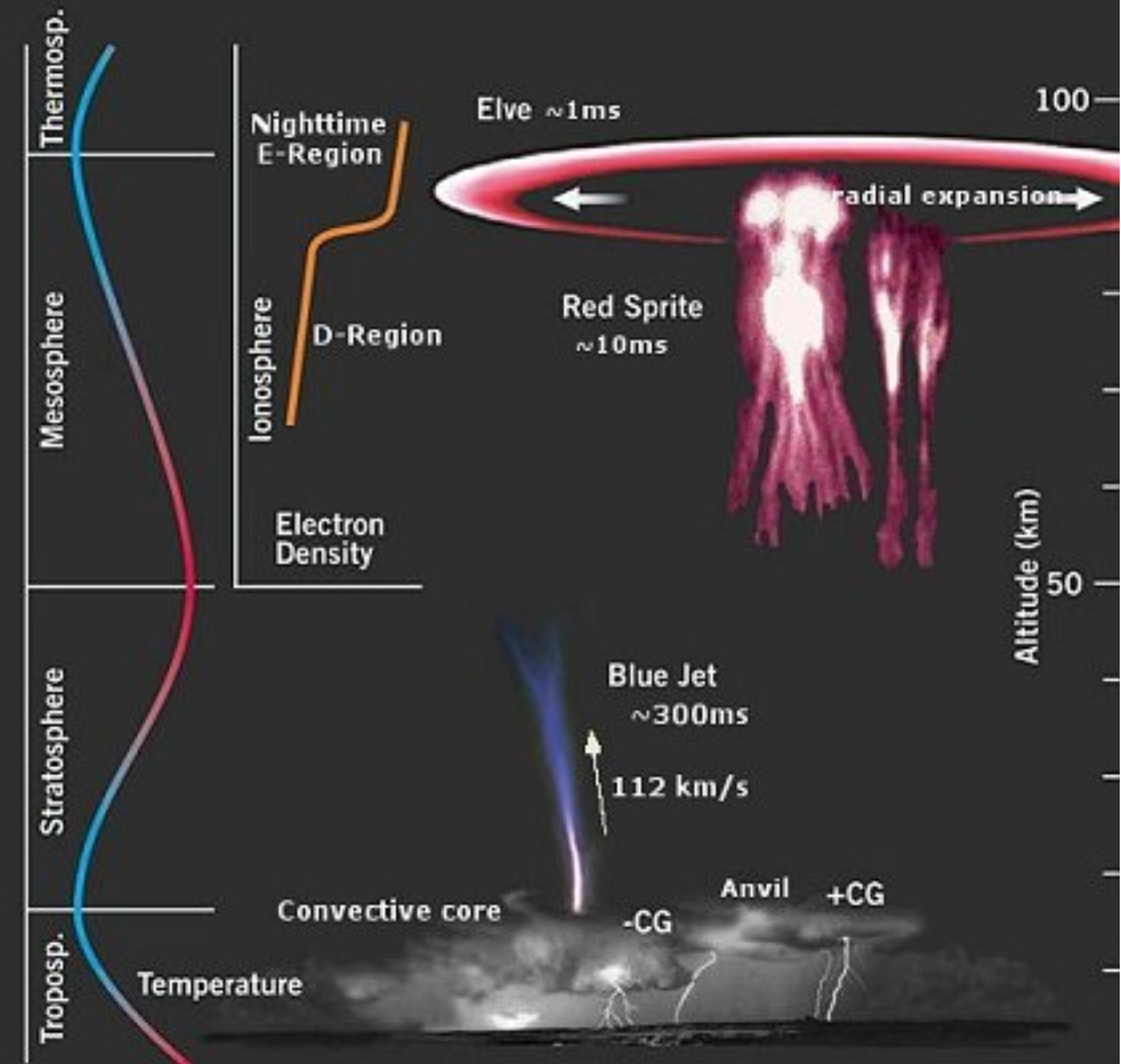 This upward lightning phenomena was first predicted theoretically in 1925 by Nobel laureate C.T.R. Wilson in his treatise Thundercloud Electric Field Theory. Sightings of blue jets had been recorded as far back as the 1880s and the development of aviation increasingly led to blue jet sightings. However, atmospheric scientists were so opinionated and influential within the field of aviation—opinions that made no allowance for what the pilots were describing—that pilots felt pressured to not report sightings because they would be accused of “seeing things” or of being impaired.
High flying aircraft eventually videoed the phenomenon in the early 1990s.
Scientists still do not yet understand why blue jets occur. However, what they are seeing is altogether consistent with the presence of an inner ionosphere in this region. A region containing free ions is what is necessary to create the diffuse visual signature of blue jets. And blue jets occur exactly where The Urantia Book asserts that there is an inner ionosphere.
Adding to the intrigue of this issue is that the authors of The Urantia Book state that they were very restricted regarding the impartation of unearned scientific knowledge and that they would make use of the existing human sources when expressing concepts. On the other hand, there is a little flexibility in that it also states the authors had permission to integrate “about-to-be-known facts and observations.” These comments inspired the search for human sources that may have been used by the authors of The Urantia Book. One of the strongest parallels ever to be found between The Urantia Book and other writings concerns a description of the atmosphere written in the first half of the twentieth century by Harlen Stetson. What is interesting about this comparison is that The Urantia Book authors clearly seemed to use the organization and choice of words employed in Stetson’s article but then departed from its substance by injecting an assertion about the existence of an inner ionosphere.
Although science does not yet specifically accept The Urantia Book’s assertion that an “inner ionosphere” exists between the troposphere and the stratosphere, it is now widely acknowledged that ionic activity regularly occurs in this region. The authors of The Urantia Book did not need to assert the existence of an inner ionosphere, something that would clearly call the book’s credibility into question by the scientific community. They could have left that information out and avoided the whole issue. Today, what once called its credibility into question, now makes it appear especially credible because of the willingness to break with what was strongly held scientific opinion at the time of publication.
Inner Ionosphere Review
This topic is concerned with The Urantia Book’s assertion that an “inner ionosphere” exists between the troposphere and the stratosphere. The troposphere is roughly the first six miles (9 to 10 km) above sea level, where we have a direct experience of weather conditions. Currently, scientists demarcate the tropopause region as the next mile or two of consistent temperature before the start of the stratosphere. From before The Urantia Book was published in 1955, the generally held belief has been and continues to be that conditions are not present between the troposphere and the stratosphere to support the type of ionic activity necessary to create visible electrical phenomena. In the late 1980’s and early 1990’s documentation of such visible phenomena began raising questions and changing this longstanding paradigm regarding the nature earth’s atmosphere.
The illustration on the following page provides a general appreciation for the current understanding of the different atmospheric regions and their characteristics.
The various UBtheNEWS topics each have their own set of specific characteristics. This topic, though timely for an initial presentation, is in the early stages of development. It will be updated periodically as scientists continue to research and analyze the phenomena associated with this topic. As a UBtheNEWS topic, the assertion that an inner ionosphere exists raises four distinct issues:
1) It is not at all a settled issue in science that an “inner ionosphere” exists between the troposphere and the stratosphere.
2) Evidence of ionic activity in the region between the troposphere and stratosphere existed before 1955.
3) At least one physicist theorized about the possibility of ionic activity developing above thunderclouds.
4) This topic raises issues related to the human sources that were used in the creation of The Urantia Book.
Multiple, documented observations of the phenomenon related to this topic did not emerge until around the beginning of the 1990’s. The discovery of this atmospheric activity does not lend itself well to being commercialized and it challenges currently held paradigms on the subject. Consequently, the science is still very much in the developmental stages. Many things related to electrical activity in the atmosphere are not clearly understood by scientists at this point in time. If we had a clear understanding of these issues, theories that support the existence of these now documented phenomena would have been given more credence. Instead, the early, undocumented sightings tended to be discounted.
The degree to which current science corroborates the existence of ionic activity between the troposphere and the stratosphere will, of course, be the primary focus of this report. The history of observations related to ionic activity will be reviewed as part of the explanation given regarding the current state of the scientific developments. But this will be addressed after creating some context for this topic as it relates to the issue of using “human sources.”
The issue of human sources in the creation of The Urantia Book comes up because The Urantia Book claims to have been written by angels. The Urantia Book explains the wisdom guiding the permissions and limitations placed on the angelic authors with regard to the presentation of information. The following quotes are germane to this aspect of The Urantia Book:
(0:0.2) We have been instructed to introduce new terms only when the concept to be portrayed finds no terminology in English which can be employed to convey such a new concept partially or even with more or less distortion of meaning. (Urantia Book: Forward, paragraph 2)
(101:4.1) Because your world is generally ignorant of origins, even of physical origins, it has appeared to be wise from time to time to provide instruction in cosmology. And always has this made trouble for the future. The laws of revelation hamper us greatly by their proscription of the impartation of unearned or premature knowledge. Any cosmology presented as a part of revealed religion is destined to be outgrown in a very short time. Accordingly, future students of such a revelation are tempted to discard any element of genuine religious truth it may contain because they discover errors on the face of the associated cosmologies therein presented.
(101:4.2) Mankind should understand that we who participate in the revelation of truth are very rigorously limited by the instructions of our superiors. We are not at liberty to anticipate the scientific discoveries of a thousand years. Revelators must act in accordance with the instructions which form a part of the revelation mandate. We see no way of overcoming this difficulty, either now or at any future time. We full well know that, while the historic facts and religious truths of this series of revelatory presentations will stand on the records of the ages to come, within a few short years many of our statements regarding the physical sciences will stand in need of revision in consequence of additional scientific developments and new discoveries. These new developments we even now foresee, but we are forbidden to include such humanly undiscovered facts in the revelatory records. Let it be made clear that revelations are not necessarily inspired. The cosmology of these revelations is not inspired. It is limited by our permission for the co-ordination and sorting of present-day knowledge. While divine or spiritual insight is a gift, human wisdom must evolve.
(101:4.5-10) Truth may be but relatively inspired, even though revelation is invariably a spiritual phenomenon. While statements with reference to cosmology are never inspired, such revelations are of immense value in that they at least transiently clarify knowledge by:
-
- The reduction of confusion by the authoritative elimination of error.
- The co-ordination of known or about-to-be-known facts and observations.
- The restoration of important bits of lost knowledge concerning epochal transactions in the distant past.
- The supplying of information which will fill in vital missing gaps in otherwise earned knowledge.
- Presenting cosmic data in such a manner as to illuminate the spiritual teachings contained in the accompanying revelation.”
The statements quoted above inspired Matthew Block to search for scientific source material that existed prior to publication of The Urantia Book that would have shaped the boundaries for what information could permissibly be imparted, given the claim of angelic authorship. His underlying belief being that, if such proscriptions are to be taken seriously, then a person ought to be able to discover the writings that existed during the time period in which The Urantia Book was created that formed the parameters of such revelatory limitations. Or, if The Urantia Book is not what it claims to be regarding its authorship, even still such human sources of the then current understandings of scientific issues ought to be discoverable. He maintains a website where he posts his research on this subject.
With regard to the section in Paper 58 of The Urantia Book that asserts the existence of an inner ionosphere, Block discovered in the June 1942 issue of Scientific Monthly an article titled Solar Radiation and the State of the Atmosphere by Harlan True Stetson. The section in The Urantia Book that makes mention of the existence of an inner ionosphere closely parallels and is consistent with this article by Stetson in most respects for several paragraphs. However, with regard to the issue of the existence of an inner ionosphere The Urantia Book departs from Stetson’s article.
Stetson’s article states, “If we look at a cross-section of the earth’s atmosphere, it may for convenience be divided into three zones or layers in which the stratosphere occupies the middle ground. The region below the stratosphere is that which contacts our immediate surroundings and provides the winds and atmospheric currents, giving rise to all our weather. We call this lower region comprising perhaps the first 5 or 6 miles the troposphere. The region above the stratosphere is the ionosphere.”
The Urantia Book says, “The lower five or six miles of the earth’s atmosphere is the troposphere; this is the region of winds and air currents which provide weather phenomena. Above this region is the inner ionosphere and next above is the stratosphere.” (58:2.6)
Because The Urantia Book’s section on the atmosphere so closely parallels the Stetson article, it is generally accepted as source material for establishing the parameters of The Urantia Book’s discussion of this issue. Naturally, for those who accept The Urantia Book’s claim regarding angelic authorship, this source material is generally referred to as “human source” material. Due to the difference between Stetson’s article and The Urantia Book regarding the inner ionosphere, there has been a spectrum of opinion about this difference based upon a person’s belief system. For those who do not believe The Urantia Book is what it purports to be, this has been used as evidence not only of human authorship, but also human fallibility. For those who do believe The Urantia Book is what it purports to be, until more recently, this issue has given rise to various types of “apologetic” and defensive responses, ranging from “The Urantia Book does not claim to be a perfect document” to “maybe someday it will be discovered to be accurate.”
“Maybe someday” may be on its way.
Referring to an “inner ionosphere” below the stratosphere has been and continues to be an assertion that is only made by The Urantia Book. However, C.T.R. Wilson, Nobel Laureate and inventor of the atomic cloud chamber, predicted upwards lightning in his 1925 treatise on Thundercloud Electric Field Theory: “The electric field of the cloud may cause ionization at great heights, the result being continuous or discontinuous discharge between the cloud and the upper atmosphere. . . The charges separated in the thundercloud may re-combine directly by a short-circuiting discharge within the cloud or by continuous or discontinuous discharges through external circuits, one such circuit including the earth and the upper atmosphere. . .”
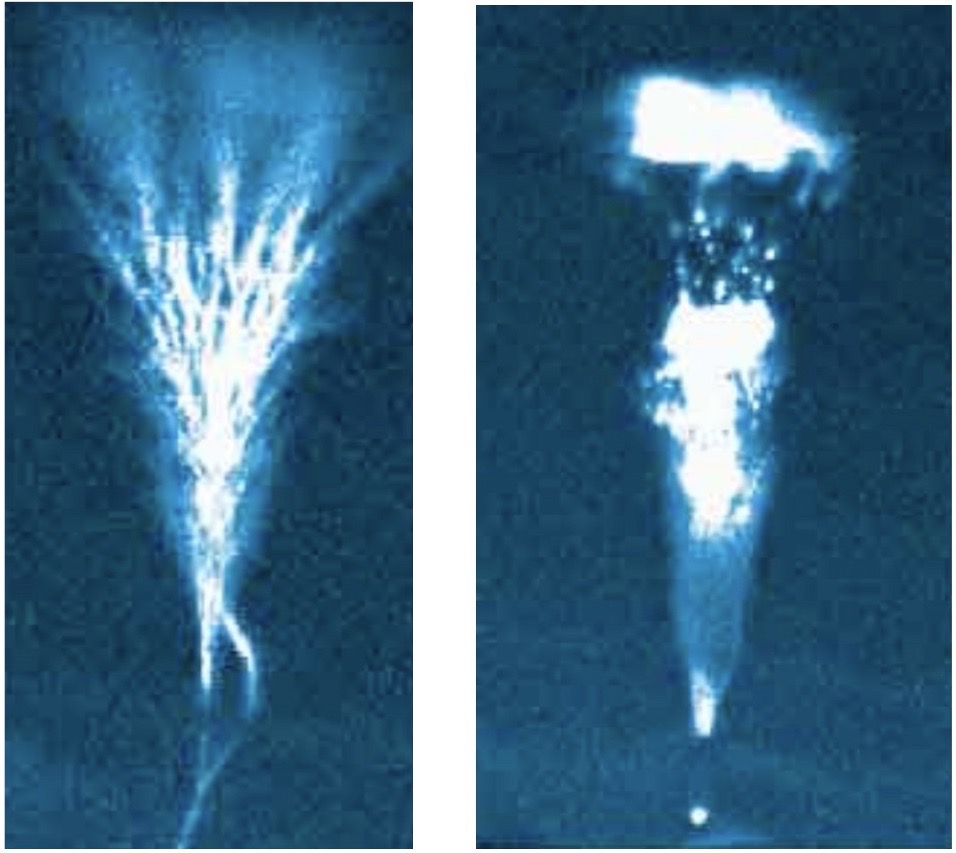
Blue jets are one of many types of upper-atmosphere electrical discharges, or “transient luminous events” currently being studied by scientists in Asia and North America. The images above were captured using low-light-level cameras, since most of the phenomena appear and disappear much too quickly for the human eye to capture. Photographs courtesy the ISUAL project, NCKU/NSPO, Taiwan
Atmospheric luminescence is generally understood to occur in connection with the presence of ions in the atmosphere. The aurora borealis is the best-known example of atmospheric luminescence associated with the ionosphere. Photographic documentation has conclusively confirmed the existence of transient luminous events (TLE’s) called blue jets, blue starters, red sprites, and elves. The documentation of these TLE’s has allowed for detailed analysis of their nature and behavior, and with this, a whole new field of questions has emerged in atmospheric science. Many of these questions remain unanswered. Nonetheless, research from the last twenty years on TLE’s suggests that, during storms, there is ionic presence and activity between the troposphere and the stratosphere.
Prior to the videographic documentation of these TLE’s, sightings of them had been reported. But they were very much discounted because of the lack of documentation. Known as The Weather Doctor, Keith C. Heidorn, PhD writes in a November 1, 2005 article, “Though first reported in 1886 as unidentified oddities, it was not until the last decade that the meteorological community accepted their existence.” The Geophysical Institute at University of Alaska Fairbanks published in a May 15, 1995 report that “Over the past century there have been scattered anecdotal accounts of blue or green pillars, columns or rocket like optical phenomena over thunderstorms [Corliss, 1977, 1983; Wilson, 1956; Malan, 1937; Ashmore 1950; Wright,1951].” The bias against acceptance of this phenomenon in the scientific community is reflected in a National Geographic article from June 23, 2003 which states, “Airplane pilots have spotted “transient luminous events” since the dawn of aviation, “but many were afraid to report the [flashes of light] because of their elusive nature,” commented Victor P. Pasko at Penn State University’s Communications and Space Sciences Laboratory in University Park.”
If the blue starters and blue jets are accepted as indications of an inner ionosphere that exists between the troposphere and the stratosphere, then The Urantia Book is at least several decades ahead of scientific corroboration. Part of the problem in making definitive statements on this topic is that scientists simply are not sure about how to interpret what they are seeing.
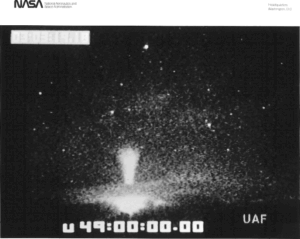
This large blue jet, shooting upwards from a thunderstorm’s top, reached an upper altitude of about 130,000 feet (40 km). These jets have been reported in anecdotal accounts over the last century. This image and other images of jets captured on the evening of June 30 [1989] are the first ever recorded. The jets appear to move at speeds of 45,000 to 223,000 miles per hour (20 to 100 km per sec). This example was captured with a very wide angle low-light, black-and-white television camera flying over eastern Arkansas at 10:03 PM CDT (03:03 UT on UT date July 1). Universal Time is shown in the upper left; other flight data is shown at the bottom. Image credit: Geophysical Institute, University of Alaska Fairbanks.
In the first several years after blue jets were first documented, these TLE’s were especially confusing because larger ones had not yet been filmed that flashed all the way up to the ionosphere that exists above the stratosphere. There had been speculation in the scientific community regarding the possibility of electrical interactions between the troposphere and the ionosphere, but not that discharges would terminate in the region directly above the troposphere or in the lower regions of the stratosphere. Such speculation received passing mention in a 2002 article on Physics Web, which states, “It was suggested more than 80 years ago that such electrical discharges could bridge the gap between a thundercloud and the upper atmosphere. But previous measurements indicated that blue jets could only reach heights of about 40 kilometers.” As recently as 2000 the University of Alaska Fairbanks described blue jets as spanning 15 to 40 kilometers (9.4 to 25 miles).
As more documentation of the blue jets continued to be compiled in the wake of the first documented sightings, increasingly occurrences of larger expressions of the phenomenon were recorded and some of these reached up to the tendrils that reach downward from the red sprites that exist in the ionosphere (above the stratosphere). The trend seems to be for scientists to focus on these more rare and larger expressions of the blue jet phenomenon because it relates to the acknowledged and somewhat understood ionosphere above the stratosphere. But as the previous quote indicates, these are not the more prevalent expressions of blue jets. Until scientists are willing to focus their attention on the blue jets and blue starters that do not reach above the lower levels of the stratosphere, as was done in the Pennsylvania State University report mentioned above, it is unlikely that an “inner ionosphere” will be commonly acknowledged to exist by the scientific community.
As larger occurrences of blue jets became documented, there also has been a diminished focus on the significance of blue starters (excepting the Pennsylvania State University report). Blue starters do not reach as high as blue jets and are considered by some to simply be a less intense expression of the blue jet phenomenon. “The blue starter, a related phenomenon, may actually be a blue jet that fails to completely form.” “Blue starters differ from blue jets in that they are brighter but shorter (reaching to only about 12 miles altitude). These were reported to occur over regions where large hailstones were falling.” The Pennsylvania State University report is generally aligned with this position on the relationship between blue jets and blue starters.
Blue starters and blue jets, because they occur in the region between the troposphere and ionosphere, indicate that this region is an important part of the picture when it comes to understanding how electric currents travel on a global level. National Geographic News published a June 25, 2003 article stating that, “Scientists have known that the global electric circuit is powered by thunderstorms, two thousand of which rage across the Earth’s surface at any given moment. These storms act as a generator, driving electric charge upwards. . .” Even though atmospheric scientists are not yet ready to identify the region between the troposphere and stratosphere as an “inner ionosphere,” current studies increasingly point in this direction. By any name it is now being widely accepted that some form of ionic activity regularly occurs in this region, creating a link that continually works to balance out the electrical charges that develop in our atmosphere.
No matter what one believes about the origins of The Urantia Book, its assertion that an inner ionosphere exists is increasingly looking consistent with emerging science on the subject. Either the angelic authors knew what they were talking about and determined that the sightings and theories in existence prior to the books publication were sufficient to keep them within the limitations imposed on them regarding the revelation of unearned knowledge. Or the human authors took an extraordinary chance by stating a position that was not at all corroborated by science at the time of publication. In either case, The Urantia Book’s assertion regarding the existence of an inner ionosphere is increasingly being supported by advancing scientific research, while the position that this statement is an error is quickly having its foundation eroded.
This large blue jet, shooting upwards from a thunderstorm’s top, reached an upper altitude of about 130,000 feet (40 km). These jets have been reported in anecdotal accounts over the last century. This image and other images of jets captured on the evening of June 30 [1989] are the first ever recorded. The jets appear to move at speeds of 45,000 to 223,000 miles per hour (20 to 100 km per sec). This example was captured with a very wide angle low-light, black-and-white television camera flying over eastern Arkansas at 10:03 PM CDT (03:03 UT on UT date July 1). Universal Time is shown in the upper left; other flight data is shown at the bottom. Image credit: Geophysical Institute, University of Alaska Fairbanks.
Read a pdf of the original UBtheNEWS presentation of this report.
 Updates:
Plain Language Summary
It has been a matter of interest, if electromagnetic fluctuations caused by lightning can propagate from the lower atmosphere higher into the ionosphere, which is an ionized and electrically conducting medium. This process requires conversion of the electromagnetic perturbation propagating in the neutral atmosphere into an ionospheric plasma wave, which for ultralow frequencies (ULF) can attenuate strongly the wave amplitude. The attenuation is considered to be rather significant, thus one could argue that it is virtually not possible to observe the ionospheric magnetic field perturbations caused by lightning using currently available satellite magnetometers.
There are many remote observations of lightning and direct satellite measurements of ionospheric magnetic field fluctuations, that can be analyzed searching for a possible link between the two phenomena. Using Swarm satellite measurements and two types of lightning observations, we provide an evidence that lightning generate electromagnetic perturbations that propagate into the upper ionosphere and can be measured with magnetometers onboard low-Earth orbit satellites, for example, by the Swarm constellation. We reveal links between lightning and ionospheric wave properties, that suggest a real causality relationship between the two phenomena. To our knowledge, this is the first direct experimental confirmation of such a relation in the ULF range.
Introduction
The term ‘sporadic E (Es)’ was first used to describe the abnormal nocturnal E layer at nearly 105 km in the early 1930s when the term ‘ionosphere’ was introduced by Watson–Watt at the UK’s Radio Research Station to designate the ionized layers in the Earth’s upper atmosphere. These previous records suggest that the occurrence of Es layers (nocturnal E-region ionization) is correlated with not only the occurrence of magnetic storms but also the occurrence of thunderstorms. An enhancement of the ionospheric Es layer due to lightning was later reported by a statistical superposed epoch analysis (SEA) and confirmed by following studies. The time delay between thunderstorm activities and the response of Es layers is associated with the tidal periodicities in the Es variability. For the mid-latitude, the most widely accepted mechanism for the production of Es layers is the wind shear theory. Patches of ionization within Es layers form as a result of the vertical ion convergence driven by vertical shears in the zonal neutral wind (a westward wind increasing with altitude) and meridional neutral wind (a northward wind increasing with altitude for the Northern Hemisphere, or a southward wind increasing with altitude in the Southern Hemisphere). The wind shear theory indicates that the formation of Es layers should be inhibited on the magnetic equator, because the ions fail to converge vertically into a layer when the magnetic field is horizontal. The equatorial Es arises from the gradient instability and is associated with the enhanced electro-jet current. Based on the expression for the vertical ion drift in wind shear theory, the vertical velocity of ions is very small when cosI ∼ 0. Here, I denotes the magnetic dip angle. So the ion-convergence mechanism does not work efficiently at high magnetic latitudes, but the vertical effects of gravity waves and electric field are very efficient in concentrating the ionization of Es layers in the central polar cap where the magnetic-field lines are approximately vertical. The wind shear theory has been confirmed by incoherent scatter radar (ISR), meteor radar, ionosonde, rocket, lidar and chemical tracer measurements, as well as the measurements and model simulations of metal ions and atoms in the mesosphere and lower thermosphere (MLT). The main problem of wind shear theory is to explain the global morphology of Es and its seasonal distribution. [Footnotes omitted.]
2005-06-09: Lightning-induced intensification of the ionospheric sporadic E layer.
Abstract
A connection between thunderstorms and the ionosphere has been hypothesized since the mid-1920s. Several mechanisms have been proposed to explain this connection, and evidence from modelling as well as various types of measurements demonstrate that lightning can interact with the lower ionosphere. It has been proposed, on the basis of a few observed events, that the ionospheric ‘sporadic E’ layer–transient, localized patches of relatively high electron density in the mid-ionosphere E layer, which significantly affect radio-wave propagation–can be modulated by thunderstorms, but a more formal statistical analysis is still needed. Here we identify a statistically significant intensification and descent in altitude of the mid-latitude sporadic E layer directly above thunderstorms. Because no ionospheric response to low-pressure systems without lightning is detected, we conclude that this localized intensification of the sporadic E layer can be attributed to lightning. We suggest that the co-location of lightning and ionospheric enhancement can be explained by either vertically propagating gravity waves that transfer energy from the site of lightning into the ionosphere, or vertical electrical discharge, or by a combination of these two mechanisms.